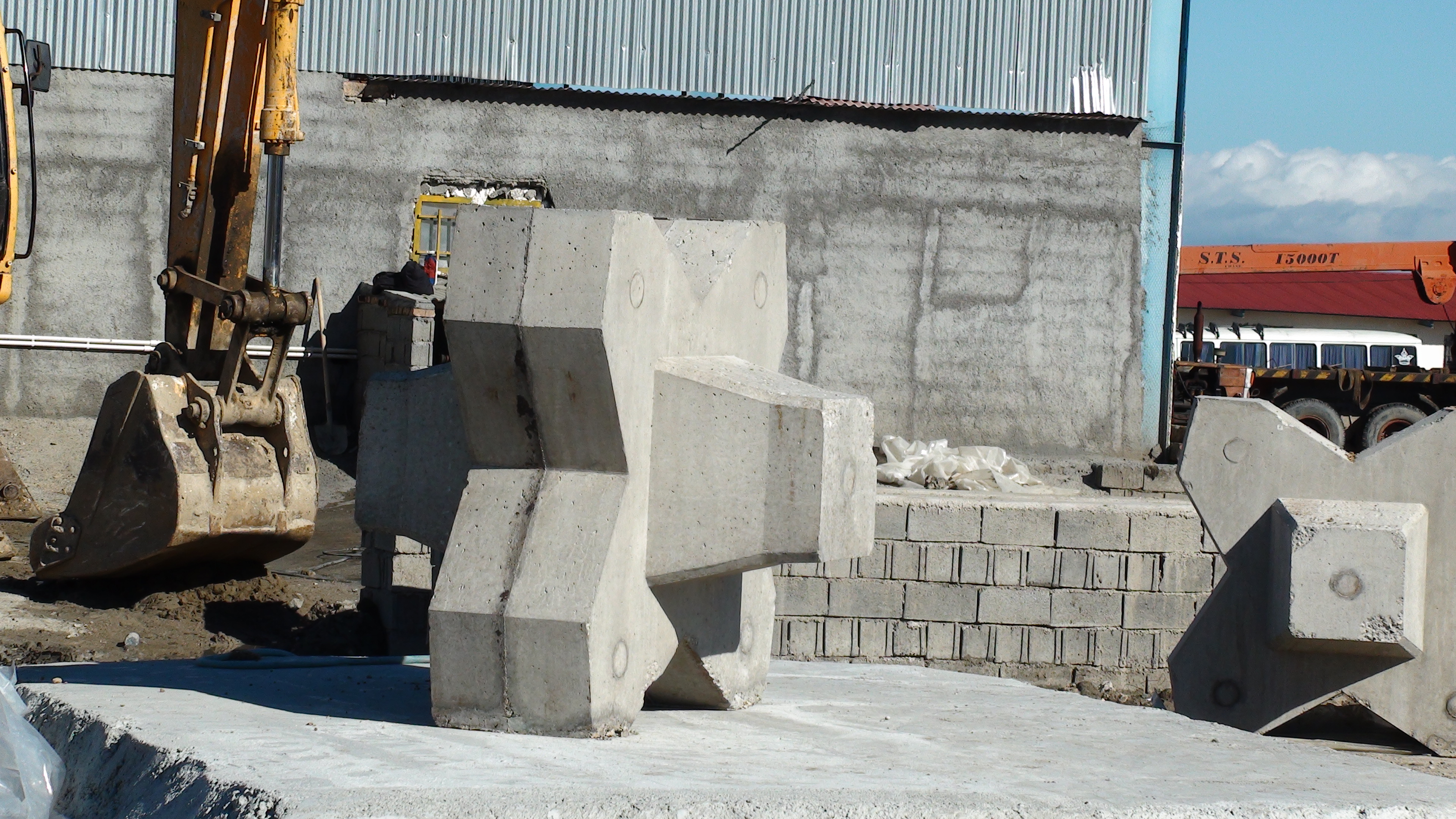
Iranian Concrete Armour Development (DEZHPOD)
Introduction
Aiming to develop a more functionally and technically efficient armour, the experts of Sazeh Pardazi Iran (SPI) Consulting Engineers reckoned as one of the Iranian front-Rank companies specializing in delivering the engineering services for the coasts, ports and marine structures, have carried out significant research efforts and eventually, managed to introduce a novel concrete armour professionally known as “Dezhpod”. The Dezhpod is a single-layer armour whose stability is provided by the interlocking interactions of the adjacent concrete blocks. Thanks to its adequate geometric shape, the Dezhpod benefits from a decent hydraulic and structural stability. In addition, ease of construction and placement are the other practically-suitable characteristics of the Dezhpod, distinguishing it from the other similar types of armors such as Accropod I. After analyzing a number of configurations with the purpose of addressing the weak points of the common types of armour units such as breakage and consequently, occurrence of subsequent progressive damage, geometry of the Dezhpod was proposed. Noteworthy, maintaining a proper balance and consistency between the hydraulic stability and structural performance, is another feature that was considered for determining geometry of the Dezhpod. The hydraulic and structural performances of the Dezhpod were numerically an experimentally assessed. In this respect, to compare the hydraulic performance of the Dezhpod arranged in different patterns with that of the other types of armours, a suite of physical model tests subjected to a broad range of waves with heights spanning from 0.5Hs to 1.25Hs, was conducted in the Marine Structures Laboratories of Tehran and Tarbiat Modarres Universities. Based on the results, in the case of conventional waves heights, the Dezhpod exhibited an excellent stability (the individual units did not incur slippage and stability of the whole system was retained) for both cases of regular and irregular arrangement patters. In most tests with the wave height exceeding the design limit (i.e., 1.25 Hs), the hydraulic performance of the Dezhpod was not severely affected and no progressive damage was observed. The armour units are exposed to the impact loads while being carried and positioned and also, when theextreme waves attack them. Since the global stability of the breakwater with single- layer armour utterly depends on the interlocking interactions between the units, the structural strength of the concrete units is of a great importance. One of the outstanding advantages of the Dezhpod is associated with its structural performance, achieved through removing the weak points observed in similar types of armour. The structural integrity of the Dezhpod has been remarkably improved by enlarging its cross-sectional areas at the critical areas that are subjected to the stress concentration. This issue was investigated by conducting numerical modeling using the Finite Element (FE) analyses. Moreover, a series of large-scale tests were performed to examine effectiveness of the structural improvements made in the Dezhpod. Promisingly, all test results indicated that the Dezhpod benefits from an excellent structural integrity compared to the other similar types of armour. Some of the large-scale fall tests carried out on the Dezhpod are:
- Free Fall test
- Tip 2 Drop test
- Tip 1 Drop test
- Hammer Drop test
 Photos

 CLIENT
R & D Activities, Sazeh Pardazi Iran Consulting Engineering Co.
LOCATIONIran
DATE OF COMPLETION2013