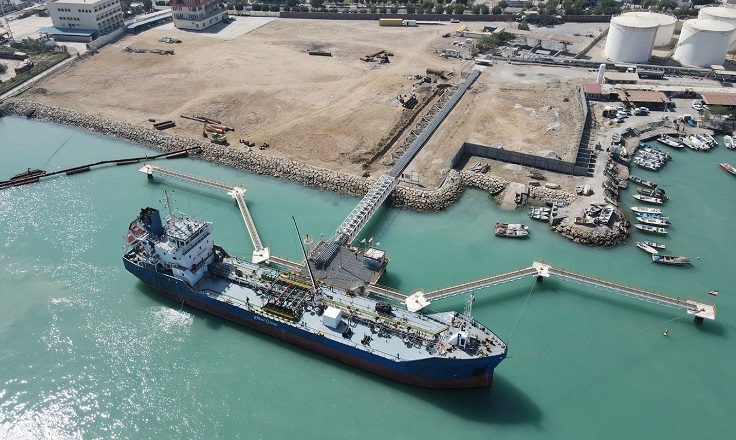
Design of Dredging and Berthing Facility at Bushehr Site
Introduction
This project has been initiated to undertake the basic and detailed engineering design for the rehabilitation of the chemical tanker berthing facilities, together with the required capital dredging, in order to accommodate vessels up to 15,000 DWT. Initially, the scope was limited to structural repair and life‑extension of the existing marine loading infrastructure—namely the main loading platform, the berthing and mooring dolphins, and the access bridge. However, based on the findings of comprehensive condition surveys, structural appraisal, and failure analyses—as well as inherent geometric and functional constraints in the legacy layout (originally configured approximately forty years ago)—it was resolved to proceed with a full redesign and renewal of the entire berthing system. During this process, state-of-the-art numerical modeling tools for the simulation of marine environments were deployed to assess navigational constraints and operability issues associated with the former arrangement.
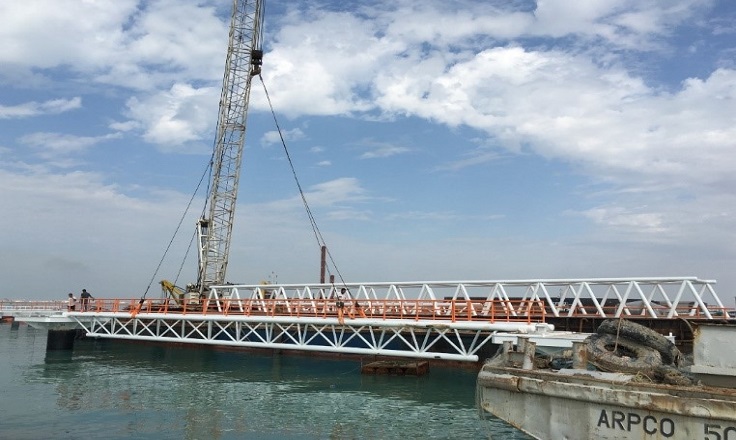
Given that the berth was required to remain in service throughout the redevelopment period, minimizing the outage window and avoiding disruption to the Company’s chemical production and export supply chain were critical project drivers. To achieve this, offshore-style modular structural systems and advanced connection technologies—commonly employed in the fabrication of oil and gas platforms—were adopted. This strategy enabled a substantial portion of the superstructure and substructure components to be prefabricated under controlled conditions in a fabrication yard and subsequently transported to site by marine means for an accelerated installation campaign.
This innovative approach delivered two principal advantages: (i) construction and commissioning durations were compressed to the practical minimum, thereby mitigating interference with ongoing terminal operations; and (ii) factory-based prefabrication, coupled with stringent quality assurance, yielded a significantly higher final build quality compared with conventional in-situ methodologies typically used in domestic port projects. Under this scheme, the steel structural elements were shop-fabricated and all specified corrosion protection systems—including multi-coat protective paint systems (and provision for future cathodic protection integration if required)—were applied and cured under controlled environmental conditions prior to load-out and installation.
 CLIENT
Commercial & Port Services of Iran
LOCATIONIRAN-Bushehr Province-Bushehr
DATE OF COMPLETION2019-2020